Basement waterproofing
Basement waterproofing
Buried walls are exposed to ground conditions and can be affected by moisture, changes in water table levels, or negative hydrostatic pressure.
Furthermore, if not properly waterproofed, over time and due to natural soil movement, the materials in the walls can crack, creating a channel through which water can seep.

Problems resulting from a failure to waterproof buried walls
Buried walls aren’t just for marking off plots or gardens. In many cases, homes also have ground floors that are in direct contact with the ground.
Therefore, if waterproofing is not applied to buried walls, groundwater could penetrate, causing:
- Structural damage: What may initially appear as a moisture stain can lead to deterioration of the building’s structure, potentially posing a risk of collapse.
- Health damage: Damp walls can encourage the growth of mold and other microorganisms, which over time can have a negative impact on people’s health.
- Excessive energy costs: Damp and poorly waterproofed walls have reduced thermal insulation capabilities, leading to increased HVAC demand.
To prevent moisture issues and costly repairs, it’s crucial to create a moisture barrier on the walls of underground ground floors. The key is to keep water from reaching the wall.
How to prevent damp walls
To eliminate wall moisture, it’s crucial to have a system that acts as a barrier and can be applied to porous substrates (concrete, mortar, or ceramic tiles).
Eagle offers two highly effective systems for basement waterproofing of buried walls. First,
UltraDry waterproof epoxy resin can absorb moisture from the substrate, even when there is high residual moisture (compatible with substrates with 98% moisture), and block moisture through negative pressure (tested at 109 bar). It also functions as a vapor barrier and acts as a radon gas blocker. Therefore, in addition to being suitable for new construction projects, it can be applied in renovation projects where eliminating moisture from walls and preventing its future occurrence is crucial.
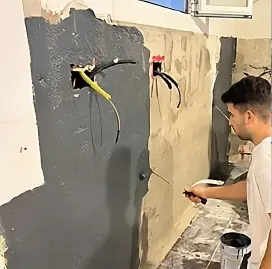
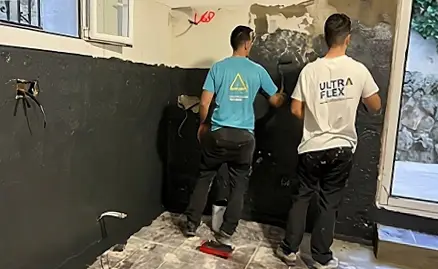
The other system for waterproofing a buried wall is UltraFlex polyurethane resin, which is applied in a fully reinforced, wet-on-wet double layer.
Both systems fully adhere to the substrate and, since they require neither overlaps nor joints, they conform perfectly to the substrate, creating a continuous waterproof membrane that is impervious to moisture in buried walls.
How to carry out basement waterproofing on a buried wall
Before applying waterproofing to walls, the surface to be coated must be clean and free of any elements that could affect the system’s adhesion. Depending on which system we choose, we’ll need to exercise varying degrees of caution regarding residual moisture.
If you choose the Ultradry waterproof epoxy resin. It is important to note that:
- To absorb residual moisture, a consumption of 200 g/m2 may be sufficient.
- To block moisture via negative pressure, a consumption of 500 g/m2 is recommended.
If we prefer to use the Ultraflex liquid waterproofing system, we will use at least 1.5 kg/m2 with Tixal added to facilitate vertical membrane application.
Related applications and keywords: cellar waterproofing, basement flooring waterproof, wall waterproofing, wall damp proof membrane, liquid damp proof membrane and basement waterproof systems.
Projects where waterproofing has been applied to walls
Renovation of an old house
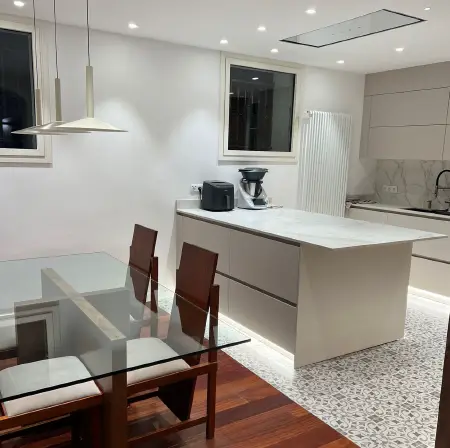
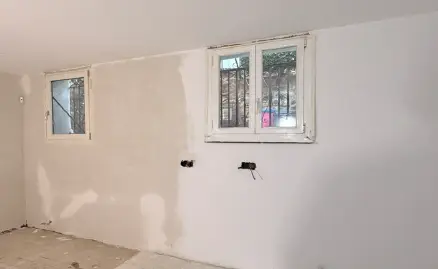
In this project, the goal was to block moisture from a semi-basement level of a 1929 house as part of a comprehensive renovation. The rear walls of the ground floor were affected by negative pressure moisture, which compromised the healthiness of the dining room and kitchen.
To correct the existing issues and prevent future problems, it was necessary to apply waterproofing to the buried walls, but this could only be done from inside the house.
To address the issue of damp walls, the wooden paneling in the dining room and the tiles in the kitchen were removed to reach the base of the substrate. This allowed the application of Ultradry waterproof epoxy resin as a moisture blocker and vapor barrier. Once the issue was resolved, the entire surface was finished with putty, decorative paint was applied, and the new kitchen was installed.
Projects completed with:

Developed to absorb moisture from the substrate (up to 98% moisture content) and block moisture through negative pressure (10 bar). It forms a vapor barrier (Sd=61). Suitable for accelerating the curing of “green concretes.” Tested as a barrier against radon gas.