

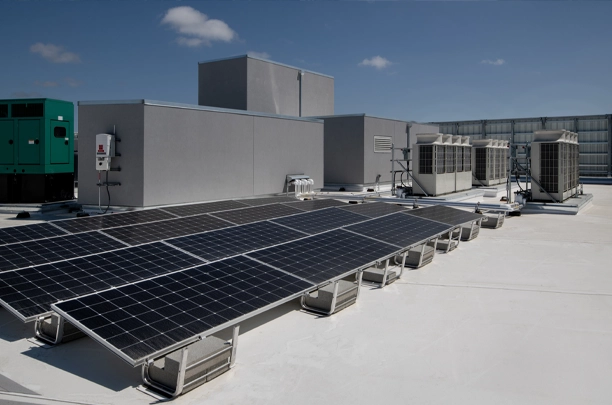
Waterproofing is key to ensuring durability, maintenance and performance
The growth of solar installations on rooftops makes waterproofing a strategic element in protecting buildings and facilitating the long-term maintenance of photovoltaic installations.
Solar energy continues to gain prominence in the European building sector. According to SolarPower Europe, during the first half of 2026, the European Union added at least 33.8 GW of new photovoltaic capacity, 1.9% more than during the same period of the previous year.
This growth means that an increasing number of residential, industrial and tertiary-sector roofs are incorporating photovoltaic installations. Against this backdrop, waterproofing should be considered from the earliest stages of the project to ensure that the roof can protect the building and respond appropriately to the new requirements associated with the installation of solar panels.
A photovoltaic roof requires looking beyond the panels
The installation of panels changes the way a roof is used. Structures, fixings, cabling and modules occupy part of the surface and can make access to certain areas more difficult. Therefore, the condition of the waterproofing should be checked before installing the photovoltaic system, particularly in refurbishment projects.
Joints, junctions, changes in plane and overlaps are some of the areas that require particular attention during installation. Properly executed waterproofing from the outset can prevent a later issue from requiring work in an area that is difficult to access.
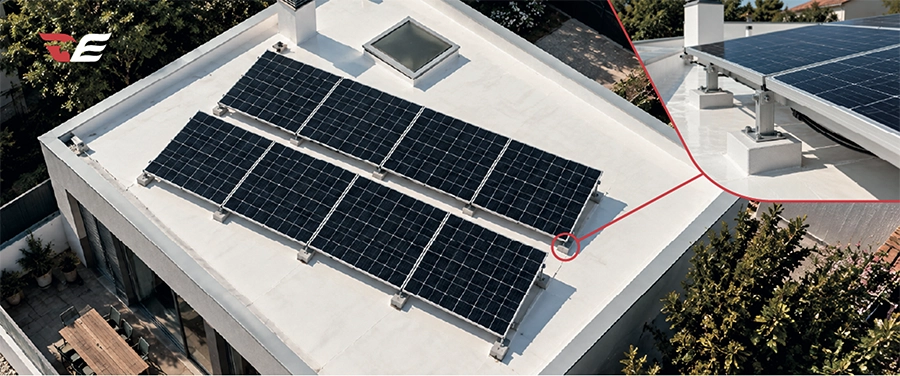
As Gemma Mogas, Partner and General Manager of Eagle Waterproofing Ibérica, Eagle Group’s European subsidiary, explains: “We are increasingly seeing roofs that are no longer simply protective surfaces, but are becoming genuine technical infrastructures. Waterproofing must evolve alongside them and provide solutions that combine durability, ease of maintenance and efficiency.”
In this regard, liquid systems offer a particularly interesting advantage: their ability to create a continuous membrane and adapt to different roof geometries and junctions, reducing reliance on individual components, joints and overlaps.
Repairs can be more complex after panels have been installed
The choice of waterproofing system becomes even more important when considering long-term maintenance. A leak that appears years later may require identifying the source of the problem and accessing a surface partially occupied by panels and structures.
For this reason, waterproofing should not be considered solely as a measure carried out before the photovoltaic installation, but rather as part of the overall roof planning. Choosing a solution that facilitates future interventions can save time and reduce the complexity of maintenance work.
ULTRAFLEX®, Eagle Waterproofing’s reference liquid waterproofing system, creates a continuous polyurethane membrane applied cold and adaptable to different substrates and roof configurations. Its wet-on-wet system allows the layers to be applied without waiting times between them, facilitating installation.
Roof temperature also matters
In addition to ensuring watertightness, a photovoltaic roof must take its behavior under solar radiation into account. Reducing surface heating can contribute to improving the roof’s energy efficiency and supporting the overall performance of certain photovoltaic configurations.
In this regard, Cool Roof solutions can reduce solar radiation absorption through highly reflective finishes. CoolTop®, from Eagle Waterproofing, is a reflective polyurethane coating that can be applied as a finish over waterproofing systems such as ULTRAFLEX®. It is also compatible with photovoltaic installations and is designed to help control the roof’s surface temperature.
Another alternative is green roofs, which can also be combined with ULTRAFLEX® systems and make it possible to approach the roof from a perspective that integrates waterproofing, thermal performance and environmental solutions.
Designing today with tomorrow’s maintenance in mind
The expansion of photovoltaic energy is transforming the role of roofs. Waterproofing must evolve alongside this change, with solutions capable of ensuring watertightness, adapting to the characteristics of each project and facilitating maintenance throughout the installation’s service life.
“The goal is not simply to waterproof before installing the panels, but to develop a solution that continues to perform correctly once the roof is in service and allows the necessary work to be carried out over time,” says Gemma Mogas.
For architects, installers and maintenance professionals, integrating waterproofing into the planning of a photovoltaic roof from the outset makes it possible to anticipate potential problems and create more durable and efficient solutions.
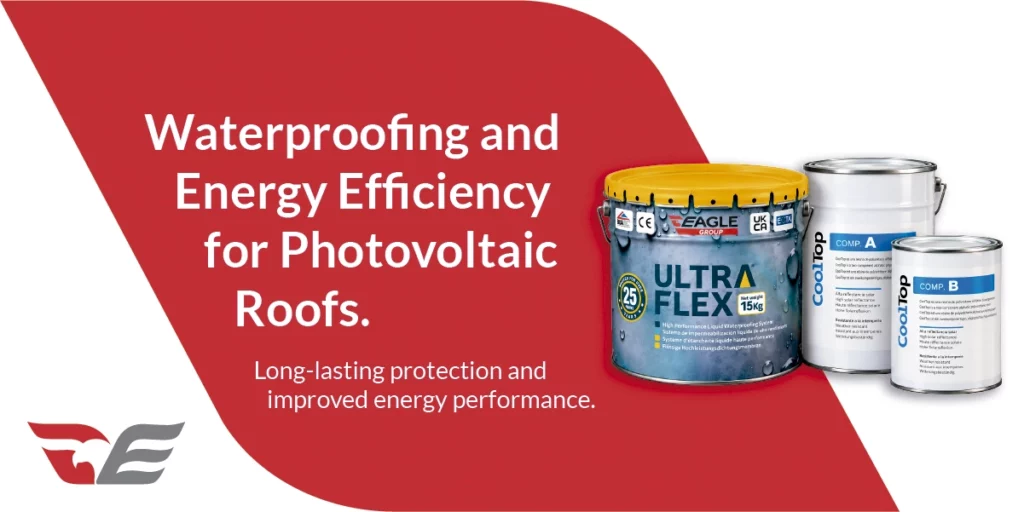
With systems such as ULTRAFLEX® and finishes such as CoolTop®, Eagle Waterproofing offers solutions designed to address the new requirements of photovoltaic roofs, combining water protection, adaptability and efficiency.
Are you preparing a project with a photovoltaic installation?
Discover how Eagle Waterproofing solutions can help you design a roof prepared to protect the building, facilitate maintenance and make the most of its energy potential.