
UltraDry Case Studies
UltraDry cases studies | Eagle Waterproofing
Real solutions | How UltraDry works.
We present real interventions in which UltraDry has successfully solved moisture problems in different construction contexts. Each case clearly explains the identified problem, the applied solution and the achieved result, helping you better understand how to block moisture caused by negative pressure and improve the durability and health conditions of interior spaces.
CASE STUDY 01
Old Single-Family Home
Interior Kitchen Wall
Objective
Block moisture through negative pressure in the walls of an old village house, built in 1929 and listed as a Modernist dwelling.
Pathology
• Single-family home with nearly 100 years of history, with a semi-basement ground floor.
• The rear walls of the ground floor were affected by moisture from the soil, causing damp stains on the interior and affecting the hygiene conditions of the kitchen and dining area.
Solution Applied
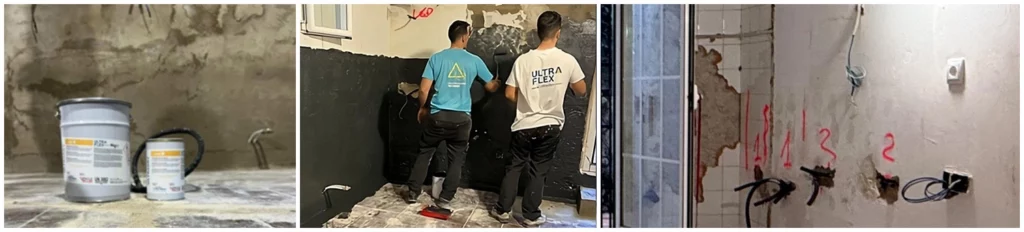
• Taking advantage of the kitchen renovation, UltraDry was applied as a moisture-blocking barrier on the ground-floor walls buried under the rear garden.
• Removal of the existing vertical cladding: wooden panelling in the dining room and tiles in the kitchen.
• Substrate cleaning and application of render to level and regularise the surface.
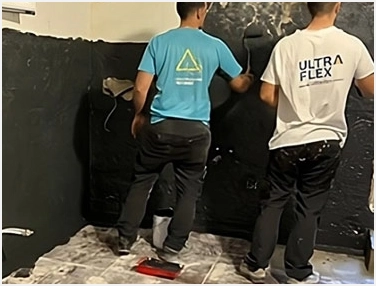
• Application of UltraDry resin by roller (450 g/m²) as a moisture blocker on the buried wall.
• Skim coating to create a smooth surface, followed by application of white paint.
• Installation of the new kitchen.

Product Used
UltraDry: Two-component, low-viscosity epoxy resin applicable in a single coat. Developed to absorb residual moisture in porous substrates such as concrete structures, mortar or ceramics (up to 98% humidity), or as a negative-pressure moisture blocker (up to 10 bar). Acts as a vapour barrier. Suitable for accelerating the curing of “green concrete”.
CASE STUDY 02
Semi-Buried Garden Wall
UltraDry | negative pressure humidity
Objective
Block moisture through negative pressure.
Pathology
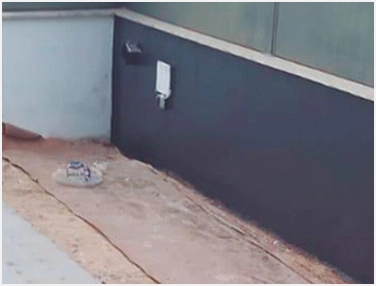
• A garden wall, buried by the adjacent property, presenting a negative-pressure moisture problem.

Solution Applied
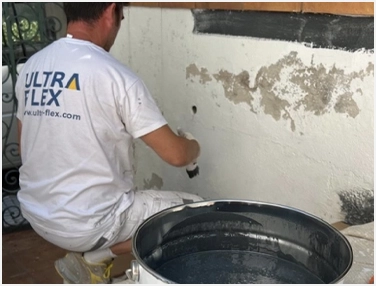
• Removal of the render down to the exposed brick.
• Application of new render to achieve a smooth surface.
• Application of UltraDry (450 g/m²) to block moisture. Tested up to 10 bar of water back-pressure.

Product Used
UltraDry: Two-component, low-viscosity epoxy resin applicable in a single coat. Developed to absorb residual moisture in porous substrates such as concrete structures, mortar or ceramics (up to 98% humidity), or as a negative-pressure moisture blocker (up to 10 bar). Acts as a vapour barrier. Suitable for accelerating the curing of “green concrete”.
CASE STUDY 03
Detached Single-Family Home
Ground Floor
Objective
Block negative-pressure moisture on the ground floor.
Pathology
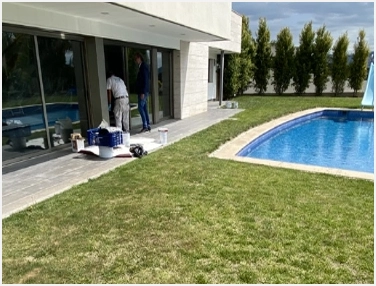
• Detached single-family home with a semi-basement ground floor on sloped terrain, surrounded by a garden with a swimming pool.
• The ground floor was affected by negative-pressure moisture from both the soil and the adjacent garden.
• The moisture had deteriorated the wooden flooring in the living room and the ceramic flooring in the kitchen. A solution was needed to block this moisture before installing a new flooring system.

Solution Applied
• Removal of the existing flooring damaged by moisture.
• Substrate cleaning by vacuuming dust and debris.
• Perimeter sealing with Ultraflex Sealant (joints with aluminium frames and perimeter gaps left by the removal of the old flooring).
• Application of UltraDry epoxy resin by roller in a thick coat (approx. 450 g/m²) as a moisture blocker.
• Broadcasting of suitably-graded aggregate over the resin as it begins to skin, to create a rough bonding surface for the new flooring.
• Installation of ceramic flooring using flexible tile adhesive directly over the UltraDry resin.

Product Used
UltraDry: Two-component, low-viscosity epoxy resin applicable in a single coat. Developed to absorb residual moisture in porous substrates (up to 98% humidity) or as a negative-pressure moisture blocker (up to 10 bar). Acts as a vapour barrier.
Ultraflex Sealant: Single-component elastic polymer adhesive (MS Polymer), with high initial tack, fast curing and high mechanical properties. Suitable for interior and exterior use. Good adhesion on damp surfaces. Formulated for sealing cracks, joints and fissures, and rapid bonding of all types of materials.
Silica sand.
CASE STUDY 04
Basement
Ground Floor
Objective
To block negative-pressure moisture in the perimeter walls of a basement in direct contact with the surrounding ground.
Pathology
• Basement with brick walls in direct contact with the ground on all perimeters.
• The walls showed signs of negative-pressure damp: efflorescence, render detachment and widespread deterioration of the internal finish.

Solution Applied
• Removal of the deteriorated render down to the exposed brickwork.
• Cleaning and preparation of the substrate.
• New render coat to regularise and level the surface.
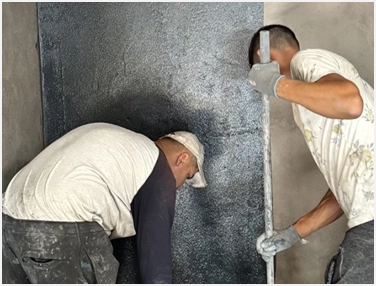
• Application of UltraDry by roller (500 g/m²) as a moisture-blocking barrier on all walls in contact with the ground.
• Filling and final painted finish.
Product Used
UltraDry: Two-component, low-viscosity epoxy resin applicable in a single coat. Developed to absorb residual moisture in porous substrates such as concrete structures, mortar or ceramics (up to 98% humidity), or as a negative-pressure moisture blocker (up to 10 bar). Acts as a vapour barrier. Suitable for accelerating the curing of “green concrete”.
CASE STUDY 05
Outer Planter Wall
Terrace & Garden
Objective
To block negative-pressure moisture in the outer wall of a planter affected by continuous infiltration from irrigation and rainwater
Pathology
• Outer planter wall of a detached house, permanently in contact with damp soil due to irrigation and rainfall.
• The negative pressure of water retained in the substrate was causing damp stains, efflorescence and finish detachment on the outer face of the wall, visible from the terrace.

Solution Applied
• The technically optimal solution would have been to remove the soil, transplant the trees, waterproof the planter from the inside and return everything to its original state. However, the cost of this intervention exceeded the available budget, and the owners had a strong attachment to an almost 80-year-old tree in the planter, making a temporary transplant unfeasible.
• As an effective alternative, UltraDry was applied to the outer face of the wall to counteract the negative-pressure moisture from the accessible side.
• Cleaning and preparation of the substrate.
• Application of UltraDry by roller (450 g/m²) as a moisture-blocking barrier against counter-pressure.
• White exterior paint applied directly onto the UltraDry to restore the original appearance of the wall.

Product Used
UltraDry: Two-component, low-viscosity epoxy resin applicable in a single coat. Developed to absorb residual moisture in porous substrates such as concrete structures, mortar or ceramics (up to 98% humidity), or as a negative-pressure moisture blocker (up to 10 bar). Acts as a vapour barrier. Suitable for accelerating the curing of “green concrete”.
CASE STUDY 06
Elevator Pit
Objective
To waterproof an elevator pit suffering from chronic water accumulation due to ground infiltration, ensuring the correct operation of the equipment and the safety of its electrical and mechanical components.
Pathology
• Elevator pit with water infiltrations from the surrounding ground due to negative pressure.
• The accumulation of waterin the pit created a permanently damp environment that put the elevator’s electrical and mechanical components at risk, compromising its operation and the building’s safety.

Solution Applied
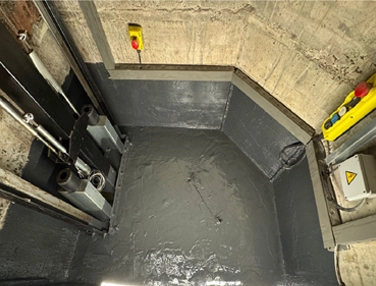
• Extraction of accumulated water from the pit and cleaning of the substrate.
• Sealing of perimeter j oints and floor-to-wall junctions with Ultraflex Sealant.
• Application of UltraDry by roller (450 g/m²) on the floor and walls of the pit as a waterproofing and negative-pressure moisture-blocking barrier.
Product Used
UltraDry: Two-component, low-viscosity epoxy resin applicable in a single coat. Developed to absorb residual moisture in porous substrates such as concrete structures, mortar or ceramics (up to 98% humidity), or as a negative-pressure moisture blocker (up to 10 bar). Acts as a vapour barrier. Suitable for accelerating the curing of “green concrete”.